
When I hear the word “wrestling,” the first thing I think about is how much one of my aunts LOVES WWE. I originally thought WWE embodied wrestling, but as it turns out, their matches are highly choreographed and scripted. It wasn’t until I read Anthony Robles’s memoir Unstoppable: From Underdog to Undefeated: How I Became a National Champion that I learned of real wrestling being completely different from WWE. I had heard of Sumo wrestling but never “amateur wrestling.” It’s a paradoxical term, because “amateur wrestling” happens at the collegiate and Olympic levels. I had also never heard of a points system nor specific technical moves in wrestling such as the ball and chain. That’s terrible of me to admit, isn’t it?
Even though I’m not into wrestling or any other sport, I was really excited to watch Unstoppable on Prime Video! I read Anthony’s memoir beforehand, so you can trust that my review will be fair and balanced! I’ll blow professional critics out of the water—stay in the ring to see how.
CW: Mentions of domestic abuse/violence, infidelity, ableism, financial struggles, foreclosure. Read at your own discretion.

Synopsis: Unstoppable is a biopic about a wrestler named Anthony Robles, the 2011 NCAA Wrestling champion. Born with only his left leg, Anthony has had to overcome obstacles related to people’s perceptions of his abilities and disabilities. He started wrestling in 9th grade after his cousin Jesse got him to try it out. Although Anthony continuously got pinned in the beginning, he increased his athleticism and learned advantageous maneuvers to beat his two-legged opponents.
His last two years of high school saw him undefeated 96-0, and he became a national wrestling champion in his senior year. Even so, he wasn’t highly recruited for collegiate wrestling teams. They didn’t think he could perform well at that level and saw him as “too much of a risk” to take on. Of all the college wrestling teams out there, only Drexel offered him any sort of scholarship—a full-ride one at that. Anthony declined it to attend Arizona State University, where he could only join their team as a walk-on (i.e., be on the roster without an athletic scholarship). During his university years (2006-2011), he faced struggles on and off the mat that tested his ability to continue wrestling. He almost quit before his final year due to financial struggles and intense disappointment with his tournament performances. But with the support of his mother, Judy, and his own guiding principles, Anthony remained on the ASU team until his NCAA Wrestling Championship win.
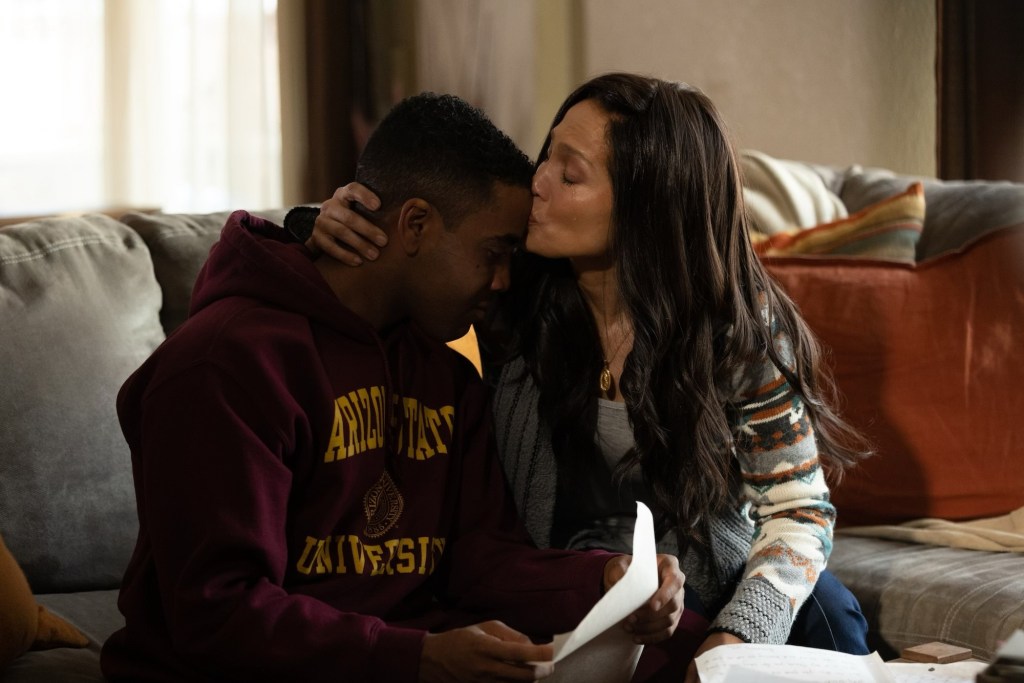
Unstoppable stars Jharrel Jerome as Anthony Robles, with Jennifer Lopez playing Judy Robles, Anthony’s mother. It also stars Bobby Cannavale as Anthony’s stepfather Rick Robles; Michael Peña as Mesa High School wrestling coach Bobby Williams; and Don Cheadle as ASU wrestling coach Shawn Charles.
Review: First off, there was no way the film was gonna be in total alignment with the memoir. It’s rare for books and films to have the same plotlines. That said, the movie script was well written! It was PERFECT to have the film’s first scene be Anthony’s final match of his high school career. He was one opponent away from becoming a national champion in wrestling, and that intriguing event compels the viewer to watch on. It’s an attention grabber that sets up the story without giving away too much. The intro couldn’t have been any stronger.
Some of the jokes in Unstoppable are simplistic, yet actually fit the tone of the story. For example, Anthony moped over his rejection from the University of Iowa in one scene. He really wanted to attend that school, as their wrestling team ranked in the top 3 nationwide. But one of the characters, particularly his boss at the plane cleaning job, said that Iowa has two things: White folks and corn. That tidbit made me laugh, especially when he added on, “We got White folks. And you can get corn on sale right down the street!”
A strong script doesn’t just come down to the words—it also comes down to the sequence of events and the presence of subtleties (i.e., showing, not telling) in the plotline. The subtleties in Unstoppable were really potent, from the holes in the wall demonstrating Judy’s anger to the perseverance shown in Anthony’s early-morning trail excursions. Judy sometimes punched those holes out of anger when Rick (named Ron in real life) abandoned her for days or weeks at a time. Rick/Ron was unfaithful and abusive to Judy on multiple occasions, and even when he swore he was a “changed man,” he often broke his promises and deserted soon after.
On the subject of casting, Jharrel Jerome ATE THE S**T out of his role! He spent a long time preparing to play Anthony in Unstoppable, but not only that, Jharrel did an incredible job portraying raw emotions. He’s a natural actor, and with him being an Emmy winner for When They See Us, you’d think he had been in more high-profile productions by now. But nope. He hasn’t been in that many roles since his win. I know for sure that if Jharrel were White, people would fawn over him the same way they fawn over Timothée Chalamet, Jeremy Allen White, and Jonathan Bailey. It infuriates me that White privilege remains deeply entrenched in Hollywood. There hasn’t been much energy put into turning young Black thespians into household names.
Also, J.Lo has once again proven herself to be a SEVERELY underrated actress. The roles she normally gets cast in really don’t allow her to showcase her true acting abilities. Though when she does get cast in serious roles, she really shines with her nuanced portrayals of outer emotions. Making a compelling portrayal of any character, fiction or nonfiction, means understanding how facial expressions, body language, and vocal tone carry nuances that impact characterization. J.Lo successfully captured Judy’s multifaceted essence through the mannerisms she brought on screen, and she resembled Judy in terms of looks too. When she yelled, “WHAT ARE YOU LOOKING AT?” at the neighbors during one of the scenes, I was shooketh. Her voice was chilling in the best way.
As for the other cast members, Bobby Cannavale was perfectly casted as Rick. Although Rick is an unlikable person, Bobby portrayed his brashness very comically. His performance was enjoyable to watch, because you know how some bad guys come across as funny even when they’re serious? Yeah, that was the vibe I got from Bobby’s Rick. And Don Cheadle is a whole acting legend—he felt like a real sports coach with how he portrayed Shawn Charles’ demeanor: sympathetic, yet brutally honest. No one else could’ve played that role better.
There were similarities, yet mostly differences between the movie and memoir. Some of the events that happened in both of them were Anthony’s job cleaning private jets, Judy’s blood donations for extra money, and the looming foreclosure of the Robles family home. The part where Judy donated blood was just as emotional to watch as it was to read. And in the film, the home’s foreclosure was postponed due to an error from the bank’s end regarding the mortgage. That part might seem embellished, but it actually happened in Anthony’s real life: more specifically during the Great Recession. Bank errors were not uncommon in the late 2000s, arising over time as the result of predatory lending practices.
Now on to the movie and memoir differences: I could use up a lot of space writing about them all, but I’d rather highlight the differences that fundamentally changed the cinematic portrayal of Anthony’s story. One of them surrounds the ASU wrestling coach. In the film, Shawn Charles serves as the same coach throughout Anthony’s collegiate career. However, there was a different ASU wrestling coach before him: Thom Ortiz. Thom got fired due to the wrestling team’s lackluster performance. The stakes were high, because Arizona State’s wrestling program almost got cut entirely. Although it was saved by external support, the administration was just not satisfied with Thom’s work overall. That led to the installment of Shawn Charles, who became ASU’s new wrestling coach in 2009. Anthony was more than halfway through his collegiate wrestling years at that point, having started in 2006.
Adding on to that, the ASU wrestlers in the film said that they would only stay on the team if Anthony did. In real life, however, two wrestlers transferred to different collegiate teams. It wasn’t an instance where the others were only gonna stay if he did. The jeopardization of the wrestling team brought uncertainty to everyone’s futures, so contemplations of transferring were not uncommon.
(And totally unrelated to the plot, but there were wrestlers wearing UNC singlets! Anthony made no mention of UNC-Chapel Hill wrestlers in his memoir, but gee, they would’ve been interesting to hear about as a soon-to-be alumna.)
The most glaring difference of all concerns the portrayal of Anthony’s match against Matt McDonough, the 2009 and 2010 NCAA Wrestling champion. The final match of Anthony’s career was branded as a rematch against Matt in the movie. However, he did not go up against Matt twice in real life—he only went up against him once in 2011. Anthony did not make the final two the year before. Also, the movie portrays their match as neck-and-neck. But the real match shows something completely different—Anthony scored 7 points before Matt even scored one, with the final score being 7-1. It would’ve been better if the film had stayed true to its source material and portrayed Anthony as a non-finalist in his 3rd year and a finalist in his 4th year. There didn’t need to be any changes with that part.
A couple of critiques I’ve seen on the Unstoppable film are that it’s “generic” and “formulaic.” That critique is not invalid, but the “generic” and “formulaic” labels are overly broad. They don’t help with explaining how Unstoppable could have been better, and so those critics come across as somewhat prejudiced. I can articulate in more concise terms what they may have been trying to say: that the movie could’ve implemented greater amounts of raw vulnerability. I personally felt the vulnerability in both the movie and memoir, but I noticed that some of the events were either removed or revised to create a more embellished, “feel good” storyline. As if things went more smoothly in Anthony’s life than they did. While I don’t believe that every inspirational story has to center trauma, this one is based on a real person. Hardships don’t need to be sugarcoated if they highly impact a real person’s backstory.
One thing the film should’ve touched more on is his losses. When Anthony wrote about the time he was dissatisfied with the “all-American” title, I empathized with him. My heart wrenched when he described crying in the locker room after his elimination at Nationals. I tasted the sweetness of victory whenever he won a match, especially against opponents he had lost to before. Each loss was painful, but Anthony always learned from them. They were a big part of his journey, and the film should’ve included those losses as part of their characterization of him. MAJOR mistake on their part.
I also think back to the fight between Rick and Judy that occurred at one point in the movie, ending in Rick’s arrest. Although when the fight occurred in real life between Ron and Judy, nobody got arrested. And Ron utilized DARVO to say that Judy, not he, was the real abuser and that the cops allegedly wanted to arrest her instead. I get that the screenwriters sought to present a more positive outcome, and it did provoke a moment of satisfaction in me. But the unfortunate reality is that domestic abusers aren’t always held accountable. Changing the outcome in the movie glossed over that reality, and it provoked ambivalent feelings in me. Would it have been better to show the fight’s real outcome rather than change it?
So, I see where critics come from with their critiques. But I also have another question in mind: would critics be calling Unstoppable “generic” or “formulaic” if Anthony were adopted from another country by White parents? I feel like the answer would be “no.” If Anthony were adopted from a country like Guatemala or Brazil by White parents, I imagine Unstoppable would’ve gained a lot more attention. Granted, people with disabilities seldom get media attention as is. But I believe critics would have sung a different tune if transnational adoption were part of the storyline. “A sports drama like you’ve never seen it before,” they’d say. “One of the year’s BEST films,” they’d call it! “The most inspirational sports movie since The Blind Side!” they’d cheer. Actually, scratch that—they’d consider it BETTER than The Blind Side!
Over the years, The Blind Side has become negatively associated with “White saviorism,” especially after Michael Oher’s lawsuit against the Tuohy family. Even so, Hollywood remains highly White normative. And given that film critics still love stories that center identity-based trauma in ways they’d consider “novel,” my point still stands.
Final Verdict: In spite of the flaws I listed, Unstoppable is an enjoyable movie that mixes cohesive screenwriting with a strong cast. Reading the memoir beforehand allows you to form balanced, substantive opinions on this film, but you can follow Anthony’s backstory without having done so. Personally speaking, if I were a screenwriter, I’d have highlighted more of the lost matches, the tension between him and his teammates, and Anthony’s internal turmoil throughout his journey. It would’ve been okay for Unstoppable the movie to show the same amount of raw vulnerability as Unstoppable the memoir. Which, by the way, I can’t recommend enough! It’s an amazing read—the full title of Anthony’s memoir is Unstoppable: From Underdog to Undefeated: How I Became a National Champion.
Also, I would’ve included a few more tidbits on Judy. Alongside being a mother, she’s a really interesting person! She originally dropped out of high school to raise Anthony, but she eventually entered college and worked her way up to a Doctorate in Educational Leadership (EdD). An additional scene or two on Judy’s life after her son’s win would’ve made for a sweet movie ending!
I’ll close this article by leaving you with this little treat:
Overall Rating: 9/10
 kristasoyyo.com
Leave a comment