
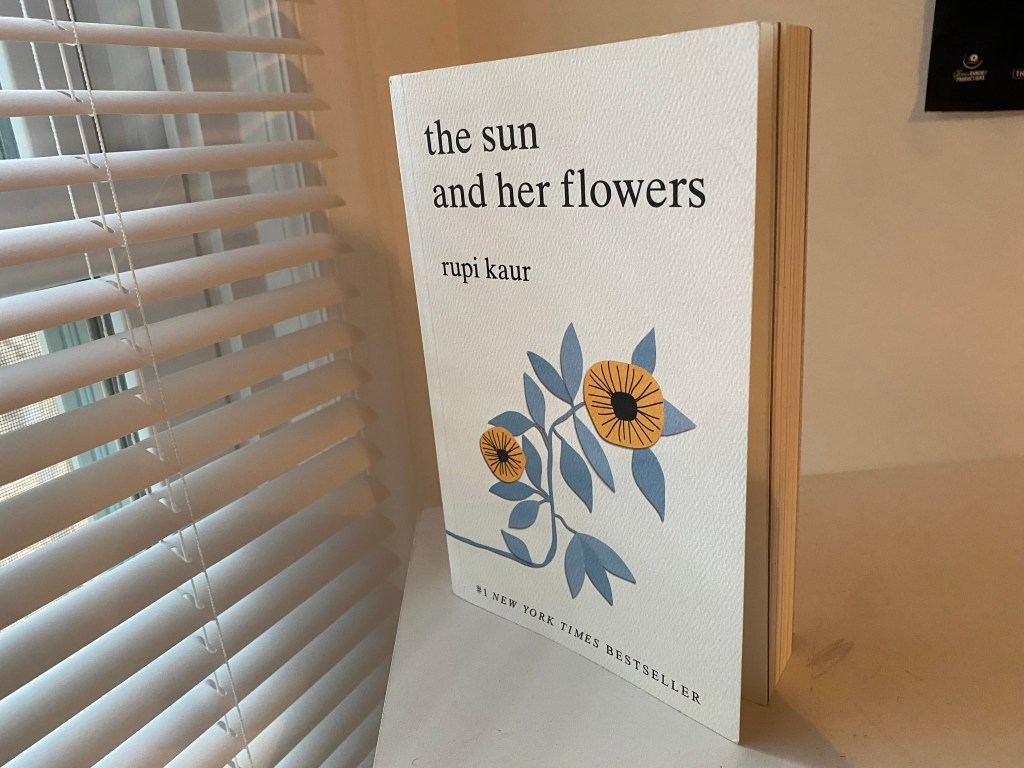
After finishing milk and honey, ‘twas time to advance to Rupi Kaur’s next poetry collection: the sun and her flowers. The title is exciting, because it’s a great play on the word “sunflowers.” However, are the poems just as enticing? This review will elaborate on that. If you have not read my review on milk and honey, go do that by clicking here. If you’ve already read it or as soon as you’re done reading it, you may proceed.
CW: Mentions of sexual and domestic violence, familial trauma, relationship trauma, depression, misogyny. A few spoilers also exist.

Synopsis: the sun and her flowers is Rupi Kaur’s 2nd poetry collection after milk and honey. Like the first book, this second book speaks about familial and relationship trauma and how those experiences have impacted her whole soul. Her detailing of hardships speaks to how she uncovers self-love, recovery, rootedness, and her life purpose. Although along the way, she deals with self-hate, grief, internal disconnectedness, and an existential crisis. The 5 chapters are “wilting,” “falling,” “rooting,” “rising,” and “blooming.” It’s based on the sentence her mom told her about how people:
“must wilt
fall
root
rise
in order to bloom.”
the sun and her flowers is a title that can actually be interpreted in different ways. Kaur’s reason for using that title is that sunflowers moving with the sun is “such a beautiful representation of love and relationships.” For example, she says, the sun could allegorize a woman and the sunflowers could allegorize that woman’s relationships. In other words, the sun-sunflower relationship symbolizes the ways in which we interact with people and different life events. It’s a very neat allegory, and a very neat way to kick off my chapter-by-chapter review, which starts now.
“wilting”
“if i’m not the love of your life
i’ll be the greatest loss instead”
-pg. 48
The “wilting” chapter seems like a continuation of “the breaking” chapter from milk and honey. It showcases Kaur’s turbulent journey through grief, including her longing for her ex’s return. Despite his abusive and unfaithful tendencies, she puts a lot of cathexis (i.e., emotional energy) into thinking about whether or not he misses her and regrets leaving her for another woman. In other words, she still has a strong attachment to him. She thinks a lot about the “what ifs” of their relationship—the positive ones she feels could happen if they were to get back together. Even so, they’re all illusions, and her ex’s warning signs indicate that even if they were to reconcile, the positive hypotheticals wouldn’t happen.
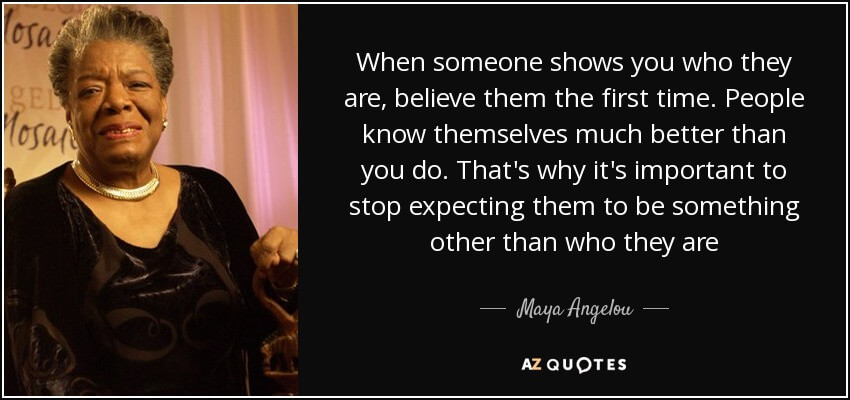
This is the time to bring in Maya Angelou’s famous quote and say, “When someone shows you who they are, believe them the first time.” Or better yet, the full quote.
The tears, shock, therapy sessions, vengeful emotions—grief is portrayed in a way where you can follow her story. The explorations on love and its definitions highlight how breakup grief can provoke an unhealthy attachment pattern. Very memorable gems from “wilting” include the poems signed “ghosts” on page 51, “i don’t need more friends” on page 53, and the one on page 48, where this section’s epigraph is from.
“falling”
The “falling” chapter focuses on mental health from multiple dimensions. It highlights depression, body insecurities, and the negative impact of sexual violence on self-esteem. “home” is one of the most sophisticated poems across her first two books. In it, she describes her own body as home and illustrates how her perpetrator made it feel unsafe.
The part where Kaur describes “washing yesterday from her hair” made me think about how hair carries deeper symbolism in “falling.” Hair symbolizes her psyche, especially with the insecurities she has about her pubic hair. She gets it shaved from one of her genitals at one point. The ways women’s bodies are discussed, from their pubic hair to their mindsets to their facial features, embody a society where consent is dismissed and is only granted if you “dress conservatively.” Archaic standards of beauty fuel the wish to be someone else or to try to be a “respectable woman.” I empathize with Kaur—upward self-comparisons and the frequent feeling of lack are really demoralizing.
The narratives in “falling” have a great chronological flow with the growth Kaur shows throughout the chapter. Towards the end, she heads towards self-acceptance and embracing one’s scars. Although as powerful as this section is, there were still stylistic issues in the writing. One of the poems, on page 105 in particular, is slightly awkward in its line structure. I saw it in this line:
“carried it in my mouth as i climbed
up my braid to the back of my head.”
At first, I was envisioning her hand climbing up to the top of her braid. In other words, I thought she was unbraiding her hair. Then, I thought briefly that she herself climbed up her own braid (which didn’t make sense). Although after rereading it, I envisioned her putting up her hair into some sort of bun style, which seems to be what she was illustrating. It goes back to what I said about milk and honey—confusion can arise from her stanza style. Pressing the “return” key at any possible moment is a choice, but not a very effective one. Enjambment, which she’s utilizing, is still an art that takes skill.
And by the way, describing a double chin as something that could “melt into her shoulders like candle wax” is flimsy and uncharmingly cringe. Like…
“rooting”
In “rooting,” Kaur speaks about her parents’ immigration journey from India to Canada. This chapter touches on the emotional journey of uprooting from one’s home country to plant roots in another. Kaur elaborates on her parents’ sacrifices, her mother struggling to learn English, the family’s dueling consciousness, and homesickness. Kaur herself was born in Punjab, India. She moved to Canada when she was 3 years old and is a native Punjabi speaker. She doesn’t mention it in this book, but in her Rupi Kaur Live special (which I highly recommend), she mentioned being teased for her accented Punjabi and her accented English as a kid. So when it comes to immigration, bilingualism, and dueling consciousness, she has firsthand experience with those subjects.
“rooting” poignantly portrays her parents’ emotions, the impact of their life choices on Kaur, and how immigration carries life-threatening risks. In the final poem of the chapter, her poetic prowess shines through in how she talks about some things being indescribable in English. Particularly the beauty of her mom’s hard work and journey. She questions why her mother should be ashamed about having an accent or making English errors when she speaks, which, as just mentioned, Kaur has gone through herself. The wording of that poem, called “broken english,” encourages artistic interpretations that make the delivery strong, which is the beauty of poetry in general.
Her mother has seen a lot, including her brother’s death, the changes emigration brought to her husband and their marriage, and has gotten a hysterectomy. Kaur gives special appreciation for her mother in all facets and wishes she could be some inanimate object to witness her mother as a young woman. She acknowledges her as not just a mother, but also a human with her own viewpoints and traits separate from her husband and children. This chapter touches on misogyny, especially with the emphasis on preferring boys rather than girls when having children, which is ironic given the expectations for cis women and girls to give birth. But sex-selective abortions are a very real issue in India, and millions of abortions have occurred against fetuses assigned female.
Another highlight is the “my god” poem. I’m an atheist, but I am also spiritual. I believe that people have control over their own destiny, and I even subscribe to the idea of treating ourselves as our own gods—praising ourselves for our greatness rather than owe it to any deity. Still, I find that poem to be thought-provoking, and I figure Kaur approached it from a Sikh perspective. Sikhi(sm) is a monotheistic religion that believes in one God, Waheguru. Sikhs believe that Waheguru is omnipotent and in all forms of matter, which Kaur illustrates with several scenarios within her poem. Where she states at the end, “my god is beating inside us infinitely”—powerful.
Despite the interesting themes throughout the poems, “rooting” is where I began seeing discord in the fluidity between poems. A few of them could’ve been taken out to improve the cohesiveness of this chapter, such as the “i will find my way out of you just fine” poem. Also, I enjoy writing which touches on social injustices and oppression. But the parts mentioning her mother’s hysterectomy and selective abortions could’ve been the seeds to a separate chapter. I’ll expand on that more during my critiques of the last two chapters.
“rising”
“rising” is where she moves on from her previous relationship. At the same time, however, she is hesitant to trust someone new. Understandably so. She shows self-awareness by expressing that her new partner shouldn’t have to take responsibility for her ex’s poor conduct. That said, her fantasies also indicate a possible rebound relationship. Like in milk and honey, Kaur showcases her state of mind through analogizing a new partner. The emotions felt between moving on to someone else, trying not to move on too fast, and longing for lifelong romance can get super messy. It’s like a push-pull type of dynamic that can intensify a honeymoon period and also intensify negative feelings once it’s over.
One thing about me though: I am PULLED into books with a cohesive, seamless sequence of events. Incohesiveness and fragmentation push me away. Honestly, the contents of this chapter should switch places with the contents of the previous chapter. In other words, this chapter should’ve been the “rooting” chapter rather than the “rising” chapter. Since Kaur writes about moving forward here, this chapter could’ve taken the meaning of “rooting” oneself in terms of regrowing after being pulled from the ground, having your stem cut, or having your petals picked off of you. Had she reorganized the contents of “rooting” and “rising,” the narrative sequence of this book would’ve been much more harmonious.
“blooming”
“blooming” is the last chapter of the sun and her flowers, taking on an empowering mood. Kaur spends this chapter celebrating women and emphasizing the importance of celebrating one’s identities. There’s a touching poem towards the end of the chapter about setting intentions for the new year. I’m thinking about putting it on a wall as a reminder to myself. The very last poem of the chapter (and book) also sums up Kaur’s new life perspectives really nicely.
Even with its highlights, organizational issues remain within “blooming.” I have the same critique with this chapter as I do for “rooting” and “rising”: it should’ve been reorganized. Really, the last three chapters needed DRASTIC reorganization. I said above that the “rising” chapter should’ve been the “rooting” chapter instead. However, some of the content in “rising” also needed to be switched with some of the “blooming” chapter content. Some of the poems in “blooming” could’ve been placed in “rooting,” and vice versa.
Remember when I mentioned the hysterectomy & abortions poems could’ve spearheaded their own chapter? To that point, Kaur could’ve combined those poems with the women empowerment poems to make the “rising” chapter. And then “blooming” could’ve tied those narratives to create the big picture vision of embracing each other’s differences and becoming greater versions of ourselves. That would’ve left room for Kaur to touch on her parents’ immigration story and the ways they keep in touch with their cultural roots, as well as on the ways gender expectations have impacted her mother. In other words, Kaur could’ve started “rising” with her women empowerment poems. Then, that could’ve flowed into her descriptions of her mother.
And then right after that, Kaur could’ve kicked off “blooming” by touching on her mother not having as much freedom as she does. The poem on pg. 211 could’ve been the first poem of the chapter, and then from there, she could’ve touched on her mother’s life in India, her emigration from there, her new life in Canada, and Kaur’s own worldviews based on her family history.
As you can tell from what I’ve been saying, a cohesive narrative sequence is SUPER IMPORTANT. It can literally make or break a story, and I do take off points for disjointed sequences. Not that everything has to make sense on its own, but never underestimate the power of a strong plot line.
Final Verdict: Despite the compelling ways in which Kaur covers trauma, there are major structuring issues in the sun and her flowers that cause discord between the chapters. Especially since she was striving to create a narrative with her poetry collection, she should have given careful attention to ensuring cohesiveness between chapters. Unfortunately, she did not adequately do that.
I’m not gonna say that you should pass on this book. I still recommend reading it, because there are powerful poems in it. That said, the most enticing thing about the sun and her flowers is the title. I gave milk and honey a 3.75/5 rating, which is not extremely high, but high enough. This book, I’m giving half a point less. You may find a 3.25/5 rating to be rather generous, but I think it’s an appropriate rating. I feel better giving it a 3.25/5 rather than just a 3/5, since I find the ways she covers different subjects to be compelling. Even her simplistic writing captivates me in ways that keep me invested in her, enhanced by her drawings spread across the pages.
I’m someone who actually thinks her poetry is better spoken than written. Her written poems I am more critical of because I look at the structure of poems as part of determining my rating. And although her written poetry isn’t amazing, her poems make GREAT spoken word material. I watched Rupi Kaur Live and her charisma on stage, her soothing voice, and her banter with the crowd—I’d pay to see her live. She’s a very talented spoken word poet, and I loved how I already knew her “broken english” poem that she performed at the end. I felt like one of the stans in the audience.
If I had listened to the audiobooks, my ratings for milk and honey and the sun and her flowers would likely be higher. I wouldn’t be giving the same scrutiny to the writing, but even then, storyline progression would still be important. The issue would remain in the audiobooks, and I’m someone who’d preferably listen to an audiobook while reading the hard copy. Still, I’m contemplating getting the audiobooks.
Overall Rating: 3.25/5
 kristasoyyo.com
Leave a comment